1
Загрузите фотографии
Загрузите чёткую фотографию анфас. При желании добавьте снимки в профиль — всего до четырёх фотографий.
Перетащите файл сюда
НЕОБХОДИМЫЕ РАКУРСЫ


The Cupid's bow, also known as the labial bow in clinical literature, is the double-curved contour at the centre of the upper lip, formed by two raised peaks flanking a midline dip. It is one of the standard subunits used to describe lip aesthetics, because its definition shapes how the mouth reads across age, sex, and ethnicity. The depth and sharpness of those peaks set how youthful and expressive the upper lip looks.
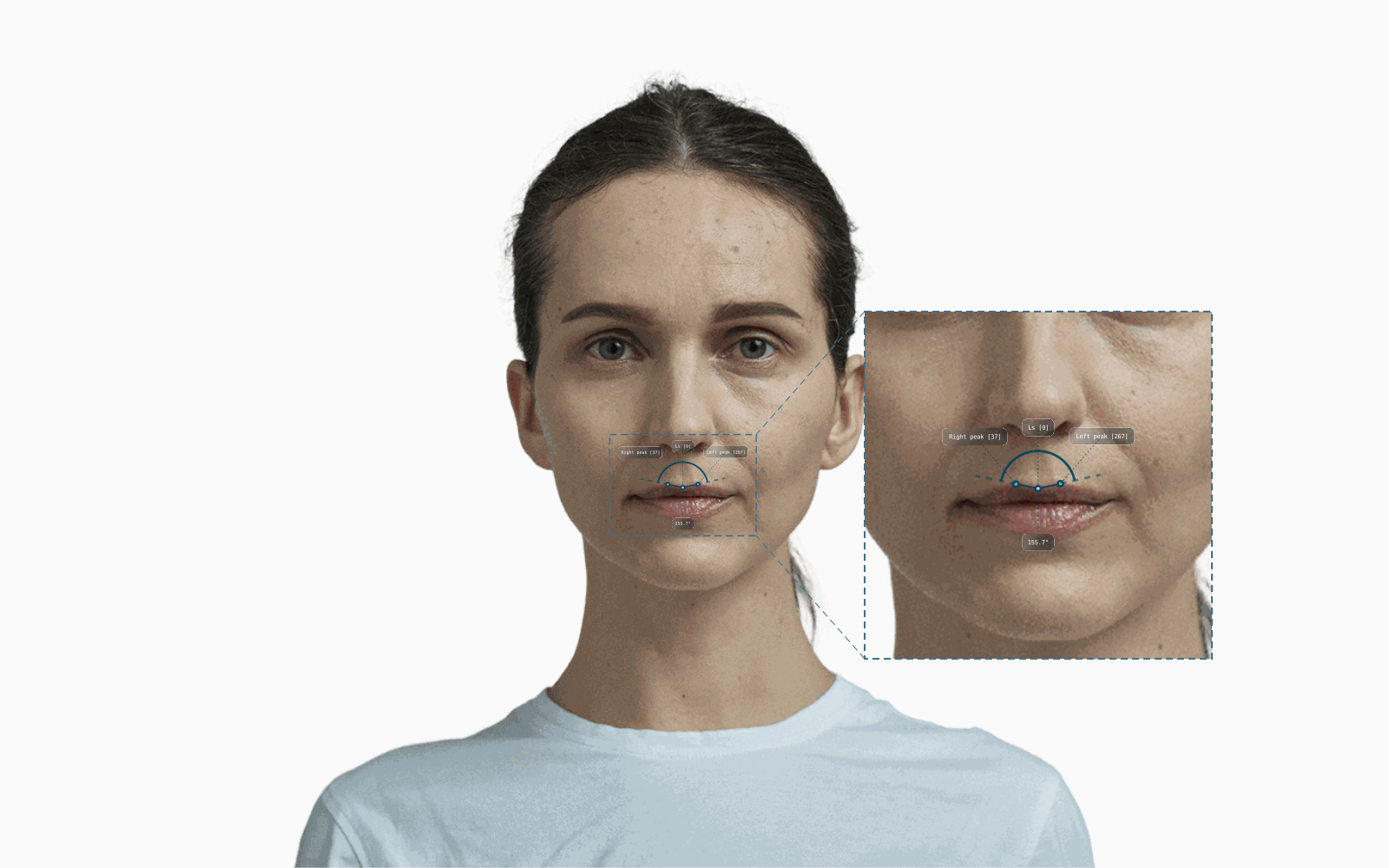
How It's Measured
The Cupid's bow is read on a front-facing photograph between three landmarks on the upper lip vermilion border (Naini, 2022). The two outer points are the high peaks of the vermilion, one below each philtral column; the central point is the labrale superius (Ls), the midpoint of the upper lip vermilion border that sits in the central dip.
The Cupid's bow angle reads at Ls, between the line running from the left peak to Ls and the line running from Ls to the right peak. A tighter angle gives a sharper, more defined bow; a wider angle reads as a flatter, softer upper lip. The vertical depth of the dip is anchored by the mid-philtral height (the distance from subnasale to the lowest point of the bow), which is the measurement most commonly reported in clinical anthropometry.

Adding upper-lip volume shifts the Cupid's bow angle from 155.7 degrees to 154.9 degrees on the same face, same lighting, same framing. The lip mass rises but the philtrum dip barely moves, so the angle changes slightly while the bow definition lifts.
Why It Matters
The Cupid's bow is one of the few facial features whose sharpness rather than size carries the aesthetic weight. Empirical work on facial perception finds that the most attractive female upper lip carries a vermilion to upper-lip ratio of about 1:1, and that a defined Cupid's bow is what makes that ratio read as full rather than swollen (Heydenrych et al., 2024). When the peaks blunt, the same vermilion volume reads as heavier and older.
Definition is also one of the clearest perioral markers of age. The textbook account of lip ageing lists loss of Cupid's bow definition and blunting of the central peaks alongside vermilion thinning and commissure downturn as the canonical changes after the fourth decade (Naini, 2022). Penna and colleagues built that observation into a four-stage classification of the ageing lip, with progressive Cupid's bow flattening anchoring the transition from a youthful type 1 lip to the elongated type 4 form (Penna et al., 2015).
On the clinical side, the Cupid's bow is a primary target for both injectable and surgical lip work. Filler protocols use linear introduction along the philtral columns to rebuild the central peaks where they have collapsed; meta-analytic evidence supports hyaluronic acid as effective and safe for this indication (Czumbel et al., 2021). The same architecture matters in reverse for cleft and revision work, where the absence or distortion of the bow drives the surgical plan rather than just the lip volume.
The ranges below show what is typical for the underlying lip dimensions across major populations.
Clinical literature sometimes labels the cupid's bow the labial bow, while the related philtrum angle describes how the philtral columns meet the vermilion border at the bow's apex.
20 ± 2 mm
Mid-philtral height (Sn–Sts), adult women
1 : 1
Most attractive female vermilion to upper-lip ratio
Decreases
Cupid's bow definition with age
Mid-philtral height anchors the vertical position of the Cupid's bow; the vermilion-to-upper-lip ratio anchors how defined it reads. Both vary by individual structure and ethnicity.
Demographic Variants
Normative lip dimensions vary by population and sex. The table below shows lit-supported ranges for the mid-philtral height (Sn–Sts), which sets the vertical depth of the Cupid's bow, and the vermilion-to-upper-lip ratio that determines how defined it reads.
Demographic | Typical mid-philtral height (Sn–Sts) / preferred ratio | Source |
|---|---|---|
Adult women, general | Mid-philtral height: 20 ± 2 mm | |
Adult men, general | Mid-philtral height: 22 ± 2 mm (longer upper lip than women) | |
Female lip, perception study | 1 : 1 vermilion-to-upper-lip ratio rated most attractive and feminine | |
Male lip, perception study | 1 : 1.8 vermilion-to-upper-lip ratio rated most attractive | |
Lip ageing, all populations | Progressive loss of Cupid's bow definition from the fourth decade onward |
Загрузите чёткую фотографию анфас. При желании добавьте снимки в профиль — всего до четырёх фотографий.
Перетащите файл сюда
НЕОБХОДИМЫЕ РАКУРСЫ
ИИ разбирает 177 параметров лица: видимые особенности кожи, пропорций, глаз, бровей и других черт. Недоступные по снимку показатели не измеряются.


Вы получите план с описанием сильных сторон, черт, которые можно улучшить, и наиболее подходящих способов сделать это.
Отчёт Эммы
16 января 2026 года
Объяснение
Глубина морщин на лбу соответствует норме для вашего возраста и демографической группы и находится ближе к нижней границе ожидаемого диапазона.
Ваши вопросы
The Cupid's bow is the double-curved contour at the centre of the upper lip, made up of two raised peaks below the philtral columns and a central dip directly under the philtrum. It marks the meeting point of the lip vermilion and the philtrum, and is one of the standard subunits used to describe lip anatomy in clinical work (Naini, 2022). The name comes from the 'V' shape of the central depression, which resembles the bow of the Roman god Cupid.
Yes. Every healthy upper lip carries the basic Cupid's bow architecture, but the visibility varies a lot. Some lips show two sharply raised peaks and a deep central V; others sit much flatter, with the peaks barely lifting above the vermilion line. Population norms on mid-philtral height fall around 20 ± 2 mm in adult women and slightly more in men (Naini, 2022), so when a Cupid's bow looks 'absent', the underlying landmarks are usually still there. They are just less raised, less pigmented, or hidden by a thicker vermilion roll.
Yes, and this is one of the better documented perioral ageing changes. The supporting connective tissue loses volume and the orbicularis oris loses tone, which blunts the central defining points and flattens the philtrum. Loss of Cupid's bow definition is listed as a canonical lip ageing change alongside white-roll flattening and vermilion thinning (Naini, 2022). Penna and colleagues built that observation into a four-stage classification of the ageing lip, where progressive Cupid's bow flattening tracks the move from a youthful pouting upper lip to an elongated, straighter older lip (Penna et al., 2015).
Definition comes from how clearly the lip carries its central architecture: raised peaks below the philtral columns, a clear central dip at the labrale superius, and a crisp white roll along the vermilion border that catches light. When any one of those softens with ageing, sun damage, or just genetics, the bow reads as blunted even when the lip volume is unchanged. The most attractive female upper lip in eye-tracking studies pairs sharp definition with a 1:1 vermilion-to-upper-lip ratio, which lets the peaks read as full rather than swollen (Heydenrych et al., 2024).
Yes. Hyaluronic acid filler placed along the philtral columns is the standard non-surgical move for restoring or sharpening the Cupid's bow, and meta-analytic evidence supports it as effective for lip augmentation more broadly (Czumbel et al., 2021). Penna and colleagues recommend filler or fat along the philtrum and white roll specifically when the goal is to rebuild central definition rather than to add bulk to the lip (Penna et al., 2015). A lip flip with botulinum toxin works differently. It relaxes the orbicularis oris to evert the vermilion, which can make the bow read as more prominent without actually changing its underlying shape.