1
Загрузите фотографии
Загрузите чёткую фотографию анфас. При желании добавьте снимки в профиль — всего до четырёх фотографий.
Перетащите файл сюда
НЕОБХОДИМЫЕ РАКУРСЫ


Facial width is the distance across the two cheekbones, measured between the zygion points (the most lateral points of the soft tissue over each cheekbone). In the literature it is called bizygomatic width, and it is what people usually mean by cheekbone width or having a wide face. It also sits underneath the facial width-to-height ratio (fWHR), one of the most studied numbers in face perception research.
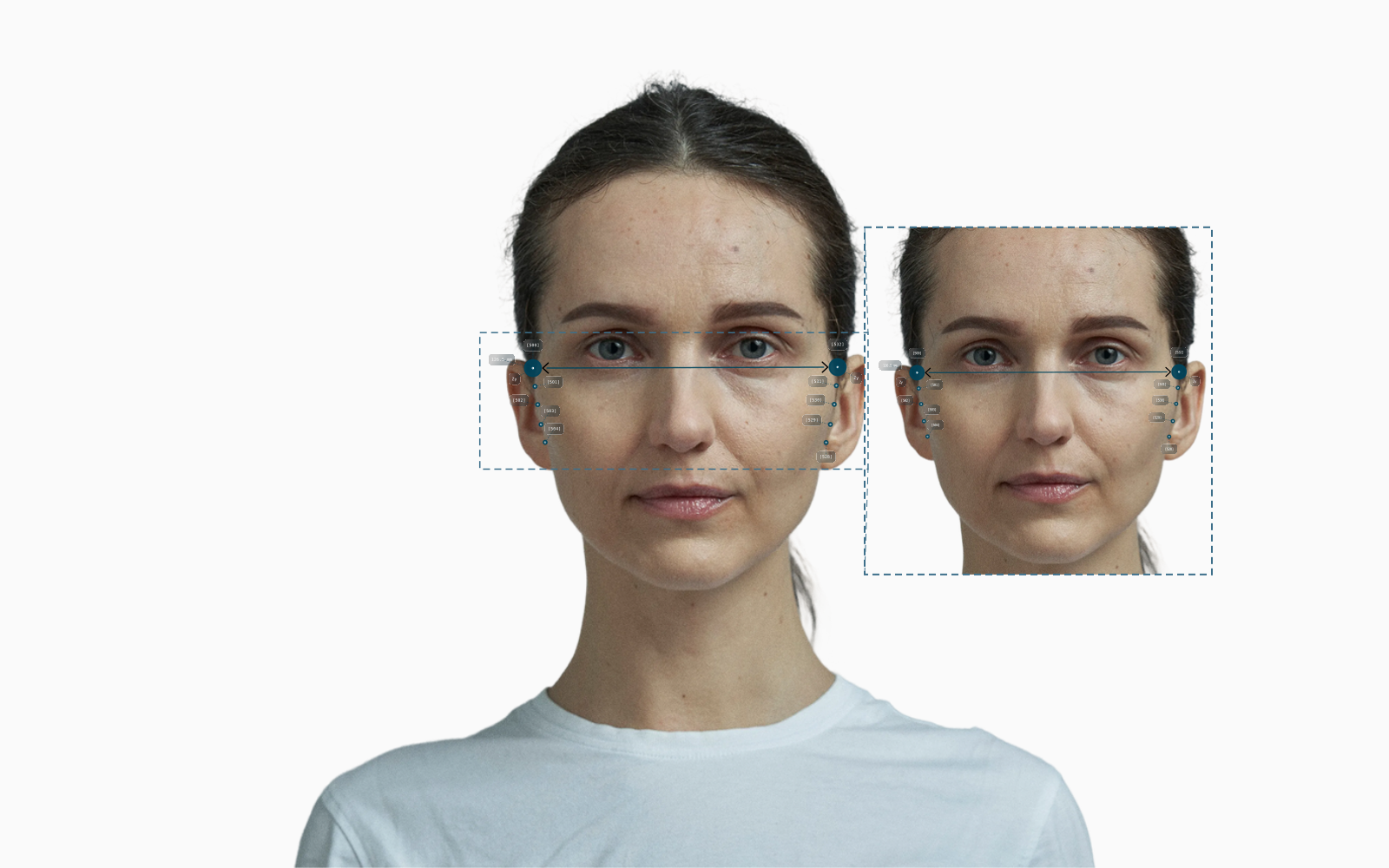
How It's Measured
Facial width is the straight-line distance between the left and right zygion, the most lateral point of the soft tissue over each cheekbone (Naini, 2011). It is read on a front-on photo, and on a well-proportioned face it should be the widest horizontal measurement of the whole head.
Read this way, facial width tells you where the broadest part of the face sits and how the rest of the outline balances around it.

Fig 1. Widening the cheekbones raised the facial width on the same face, from 0.37 to 0.41 (face width relative to face height). Same identity, same lighting, same framing.
Why It Matters
The cheekbones set the frame everything else hangs on. Facial width feeds straight into the facial width-to-height ratio (fWHR), the cheekbone width divided by upper-face height, which has been linked in some samples to how dominant or threatening a face looks (Geniole et al., 2015). A wide face has also been read as more dominant by speed-dating partners (Valentine et al., 2014).
It is worth being honest about how shaky that story is. A wide face does not reliably mean an aggressive person. Large studies have found fWHR is not consistently dimorphic between men and women and does not predict self-reported aggression (Ozener, 2012), and a multi-sample replication found it does not predict behavioural tendencies at all (Kosinski, 2017). A wide face reads a certain way; it does not tell you who someone is.
And there is no single ideal cheekbone width. Facial width tracks with population and sex. It runs broader in some groups and narrower in others, so a measurement that ignores that will misread most faces (Farkas, 2000). The cards and table below give working ranges. Read your own width against your own face height and background, not against one universal target.
134–144 mm
Men
128–137 mm
Women
128–144 mm
Typical Range
Fig 2. Approximate facial (zygion to zygion) width in adults. Cheekbone width is judged proportionally and varies with individual structure and background.
Demographic Variants
Facial width varies by population and sex, so the ideal cheekbone width is relative, not absolute. Each row links to the source that reported the pattern.
Population | Cheekbone width tendency | Source |
|---|---|---|
White Caucasian | About 139 mm in men and 131 mm in women | |
North American White | Baseline Western soft-tissue norms in Farkas anthropometry | |
African (Kenyan) | Facial breadth comparable to or wider than Western norms | |
East Asian | Broader, flatter midface with prominent malar width |
Загрузите чёткую фотографию анфас. При желании добавьте снимки в профиль — всего до четырёх фотографий.
Перетащите файл сюда
НЕОБХОДИМЫЕ РАКУРСЫ
ИИ разбирает 177 параметров лица: видимые особенности кожи, пропорций, глаз, бровей и других черт. Недоступные по снимку показатели не измеряются.


Вы получите план с описанием сильных сторон, черт, которые можно улучшить, и наиболее подходящих способов сделать это.
Отчёт Эммы
16 января 2026 года
Объяснение
Глубина морщин на лбу соответствует норме для вашего возраста и демографической группы и находится ближе к нижней границе ожидаемого диапазона.
Ваши вопросы
In Caucasian adults, facial width averages about 139 mm in men and 131 mm in women (Bahbah et al., 2023), with most people falling in a 128 to 144 mm band (Naini, 2011). The number matters less than the proportion, so a normal cheekbone width is one that reads as the widest part of the face.
A wide face usually comes down to a naturally broad facial width, the bony cheekbone span you inherit, sometimes with added soft-tissue or masseter fullness on the sides. Facial breadth is one of the more sexually shaped parts of the skull (Weston et al., 2007), so a good deal of cheekbone width is simply your underlying bone structure.
The facial width-to-height ratio is the facial width divided by the height from the upper lip to the brow (Valentine et al., 2014). Because cheekbone width is the numerator, a wider face produces a higher fWHR, which is why the two are so often discussed together.
A higher fWHR can read as more dominant at a glance, but the link to real behaviour is weak. Studies have found fWHR does not reliably predict aggression (Ozener, 2012) or self-reported behavioural tendencies (Kosinski, 2017), so a wide face is a look, not a personality.
There is no single ideal cheekbone width. The right facial width depends on your face height, sex and background, and it varies between populations rather than landing on one universal number (Farkas, 2000). What you want is balance. The cheekbones should read as the widest line, with the forehead and jaw tapering gently around them.