1
Загрузите фотографии
Загрузите чёткую фотографию анфас. При желании добавьте снимки в профиль — всего до четырёх фотографий.
Перетащите файл сюда
НЕОБХОДИМЫЕ РАКУРСЫ


The upper gonial angle is the top half of the jaw-corner angle. In Jarabak analysis, a line from gonion to nasion splits the full gonial angle in two, and the upper part, measured from the back of the ramus through gonion to nasion, tracks how the ramus of the jaw grew.
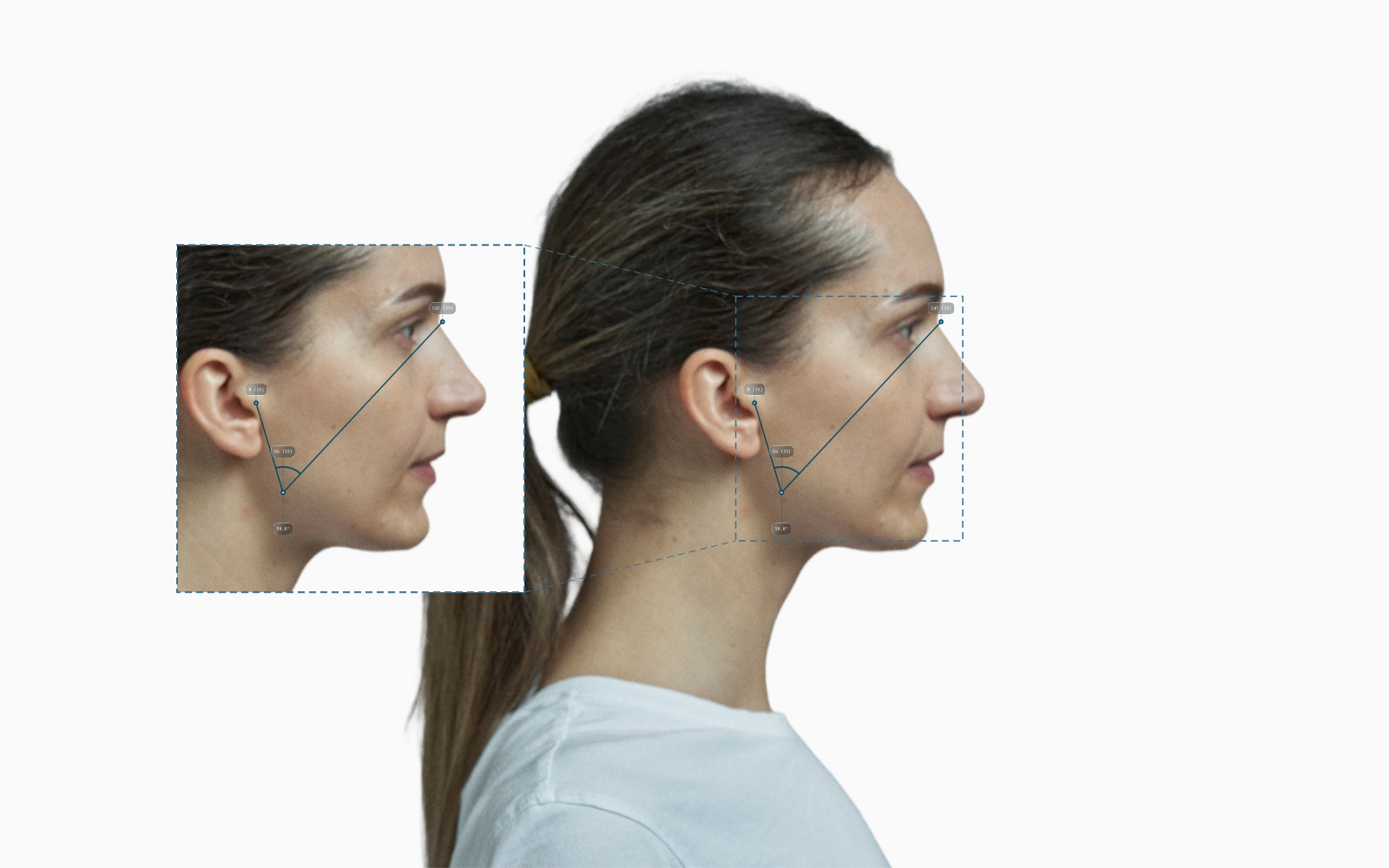
How It's Measured
The upper gonial angle is read on a side view. You take the full gonial angle at the jaw corner, then divide it with a line from gonion up to nasion. The portion above that line, from articulare at the back of the ramus through gonion to nasion, is the upper gonial angle (Jarabak norms, Nanda et al.).
The upper gonial angle reflects the ramus, the vertical part of the jaw, while the lower part reflects the body. Add the two together and you get the total gonial angle (Naini, 2011).

A stronger, squarer jaw steepens the ramus. The upper gonial angle narrows from 59.8° to 55.2° on the same face, same lighting, same framing.
Why It Matters
Splitting the gonial angle at the gonion to nasion line is what makes it diagnostic rather than just descriptive. The upper half isolates the ramus, so a taller, steeper ramus reads as a more closed upper angle, and a shorter ramus as a more open one (Mandibular assessment, 2024). That tells a clinician where a long or short face is actually coming from.
The total gonial angle is the headline number, running about 120 to 130 degrees, and it climbs in vertical growers and drops in horizontal ones (Naini, 2011). The upper and lower halves show whether that change lives in the ramus or the body of the jaw, which matters when the goal is to plan treatment rather than just label a face (Diagnostic cephalometrics, 2022).
One caution worth repeating: the upper gonial angle is not the visible jaw corner people photograph. That is the full gonial angle. This is the ramus-facing slice of it, useful in cephalometric analysis rather than as a look you can read off a selfie. The cards and table below give working values.
~52°
Men
~55°
Women
52°–55°
Typical Range
Approximate upper gonial angle (Articulare-Gonion-Nasion) by the Jarabak convention. It is the ramus-facing portion of the total gonial angle. These are textbook norms; the value moves with jaw growth pattern.
Facial Types
The gonial angle is read against jaw growth pattern rather than ethnicity, since it reflects how the ramus and body of the mandible grew. Each row links to the source.
Type / group | Gonial angle tendency | Source |
|---|---|---|
Longer ramus | Associated with a smaller, more closed gonial angle | |
Hyperdivergent (high angle) | Obtuse, wide total angle; vertical growth, longer lower face | |
Hypodivergent (low angle) | Acute, reduced angle; horizontal growth, short square jaw | |
Vertical skeletal dysplasia | Angle used with SN-GoGn and the Jarabak ratio to flag vertical growers | |
Population norms | Cephalometric norms are population-specific and differ from Caucasian standards |
Загрузите чёткую фотографию анфас. При желании добавьте снимки в профиль — всего до четырёх фотографий.
Перетащите файл сюда
НЕОБХОДИМЫЕ РАКУРСЫ
ИИ разбирает 177 параметров лица: видимые особенности кожи, пропорций, глаз, бровей и других черт. Недоступные по снимку показатели не измеряются.


Вы получите план с описанием сильных сторон, черт, которые можно улучшить, и наиболее подходящих способов сделать это.
Отчёт Эммы
16 января 2026 года
Объяснение
Глубина морщин на лбу соответствует норме для вашего возраста и демографической группы и находится ближе к нижней границе ожидаемого диапазона.
Ваши вопросы
It is the top half of the total gonial angle. In Jarabak analysis, a line from gonion to nasion splits the jaw-corner angle; the part above that line, articulare through gonion to nasion, is the upper gonial angle and sits around 52 to 55 degrees (Bjork-Jarabak norms).
The gonion to nasion line divides the total gonial angle in two. The upper angle, articulare through gonion to nasion, captures the ramus; the lower angle, nasion through gonion to menton, captures the body of the jaw. Added together they make the total gonial angle (Naini, 2011).
No. The visible jaw angle people photograph is the full gonial angle, articulare through gonion to menton, about 120 to 130 degrees. The upper gonial angle is only its ramus-facing sub-component above the gonion to nasion line (Naini, 2011).
A large, obtuse gonial angle goes with a vertical growth pattern, a jaw rotated down and back, and a longer lower face. Clinicians read it alongside other vertical measures rather than on its own (Diagnostic cephalometrics, 2022).