1
Загрузите фотографии
Загрузите чёткую фотографию анфас. При желании добавьте снимки в профиль — всего до четырёх фотографий.
Перетащите файл сюда
НЕОБХОДИМЫЕ РАКУРСЫ


The nasomaxillary angle describes how the nose sits against the midface in profile, the relationship between the nasal bridge and the maxilla below it. It belongs to the family of profile nasal angles, close in spirit to the nasofacial angle, and it is one of the cues that decides whether a nose looks balanced on the face or projected off a flat midface.
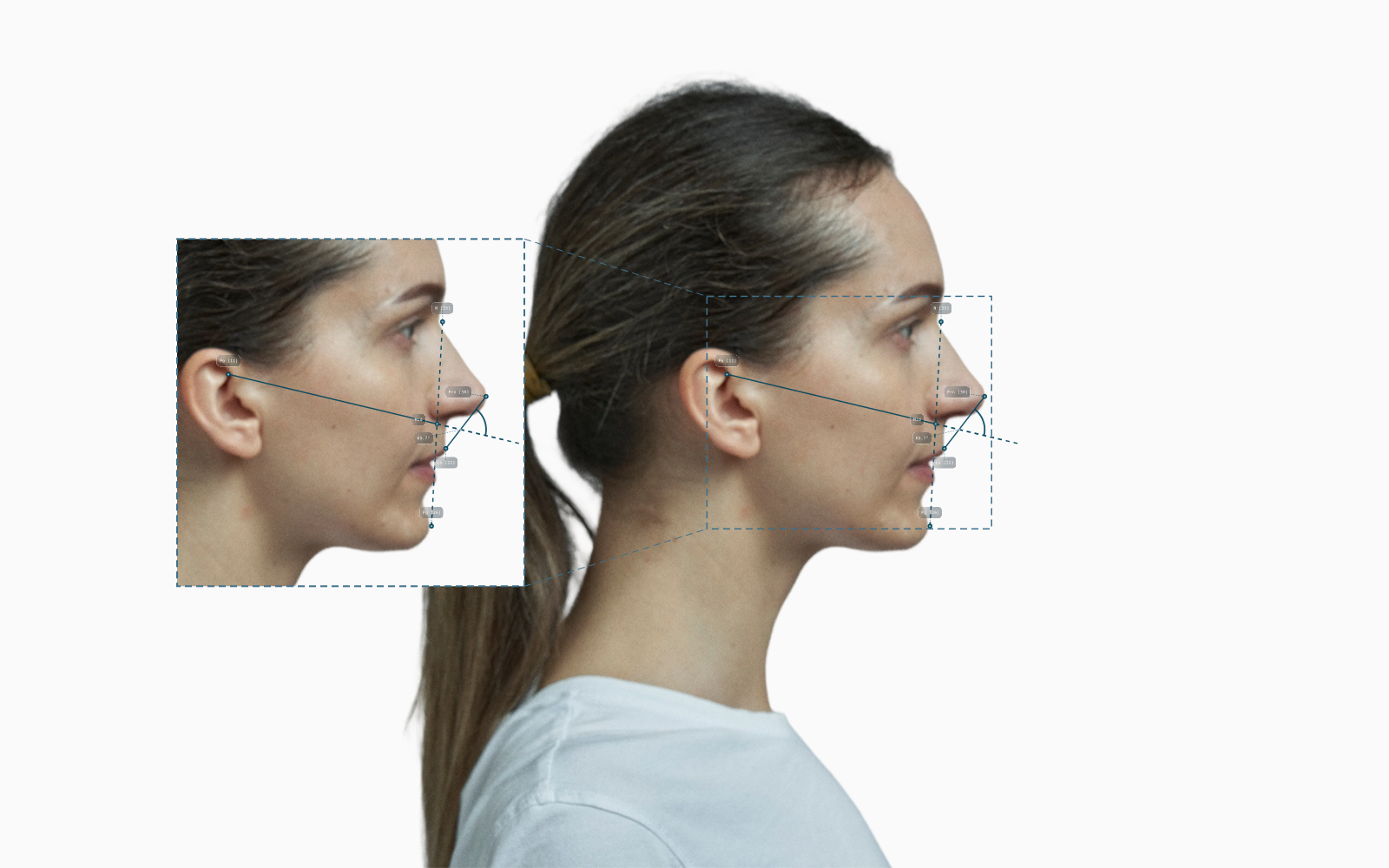
How It's Measured
The nasomaxillary angle is read on a side profile, between a line along the nasal dorsum and a facial reference through the midface, using standard soft-tissue landmarks (Nasofrontal angle photogrammetry, 2023). It is worth being precise here: nasomaxillary is not one of the classical named angles, so it is best understood as a nose-to-midface measure rather than a fixed textbook value.
Read this way, the angle is really asking how far the nose projects relative to the midface it grows from (Swennen & Naini, 2006).

Increasing nasal projection shifted the nasomaxillary angle from 65.7° to 59.6° on the same face, same lighting, same framing.
Why It Matters
A nose never reads in isolation; it reads against the midface behind it. When the maxilla is deficient and sits back, the paranasal area flattens and the same nose looks more projected and more prominent (Naini, 2011). A nose-to-midface angle is one of the first things clinicians use to spot that a big-looking nose is really a flat midface (Swennen & Naini, 2006).
Profile nasal angles are also sexually dimorphic. The nose-to-forehead and nose-to-chin angles differ significantly between men and women, so the nose carries gender-typical cues in profile (Fatemi et al., 2017). Average Caucasian noses tend to run more obtuse in these angles than the aesthetic ideal, which is part of why the average profile reads as slightly more prominent (Harris & Chan, 2005).
One honest caveat: the nasomaxillary angle is not a standardized measurement with its own published norm, and it should not be confused with the nasofrontal angle, which is a separate nose-to-forehead measure. The related angles that do have published values also vary by population, so a single ideal misreads many faces (Ethnic nasal norms, 2021). The cards and table below use the nearest cited profile angle for reference.
~129°
Men
~135°
Women
~130°
Most Attractive
There is no established normative range for the nasomaxillary construction itself. Shown here is the closely related nasofrontal angle, the nose-to-forehead transition, where cited values sit near 130 degrees in men and wider in women. Read it as a reference, not a target for this exact measure.
Demographic Variants
Because the nasomaxillary angle has no published norm of its own, the table gathers the related profile nasal angles, which are well studied and vary by sex and population. Each row links to the source.
Group | Profile-angle tendency | Source |
|---|---|---|
Men (nasofrontal) | Around 129 degrees on average | |
Women (nasofrontal) | Wider and more open, around 135 degrees | |
Most attractive male profile | Nasofrontal angle near 130 degrees | |
Deficient maxilla | Flat paranasal region makes the nose look more projected | |
Across ethnicities | Ideal nasal inclination is population-specific, not universal |
Загрузите чёткую фотографию анфас. При желании добавьте снимки в профиль — всего до четырёх фотографий.
Перетащите файл сюда
НЕОБХОДИМЫЕ РАКУРСЫ
ИИ разбирает 177 параметров лица: видимые особенности кожи, пропорций, глаз, бровей и других черт. Недоступные по снимку показатели не измеряются.


Вы получите план с описанием сильных сторон, черт, которые можно улучшить, и наиболее подходящих способов сделать это.
Отчёт Эммы
16 января 2026 года
Объяснение
Глубина морщин на лбу соответствует норме для вашего возраста и демографической группы и находится ближе к нижней границе ожидаемого диапазона.
Ваши вопросы
No. The nasofrontal angle is measured between the forehead and the nasal bridge at nasion, around 130 degrees in attractive male profiles (Photogrammetry, 2023). The nasomaxillary angle describes the nose against the maxilla and midface instead, a different reference line.
There is no single agreed norm for this exact construction, because it is not one of the classical named profile angles. The closest well-studied reference is the nasofrontal angle, which averages roughly 129 degrees in men and 135 degrees in women (Kalita et al., 2023).
A deficient, backward-set maxilla flattens the paranasal area and reduces support under the nose, so the same nose projects further off the face and looks larger than it is (Naini, 2011).
Yes. Profile nasal angles, including the nose-to-forehead and nose-to-chin angles, differ significantly by sex, with women tending toward more open, obtuse angles (Fatemi et al., 2017).