1
Загрузите фотографии
Загрузите чёткую фотографию анфас. При желании добавьте снимки в профиль — всего до четырёх фотографий.
Перетащите файл сюда
НЕОБХОДИМЫЕ РАКУРСЫ


Nasal tip projection is how far the tip of the nose stands out from the face when you look at someone from the side. You will also see it called nose projection. Clinicians put a number on it with the Goode ratio, a small triangle drawn from the bridge of the nose out to the tip and back to where the nostril meets the cheek. That one ratio is a big part of whether a nose sits in balance with the profile or reads as pinched or overdone.
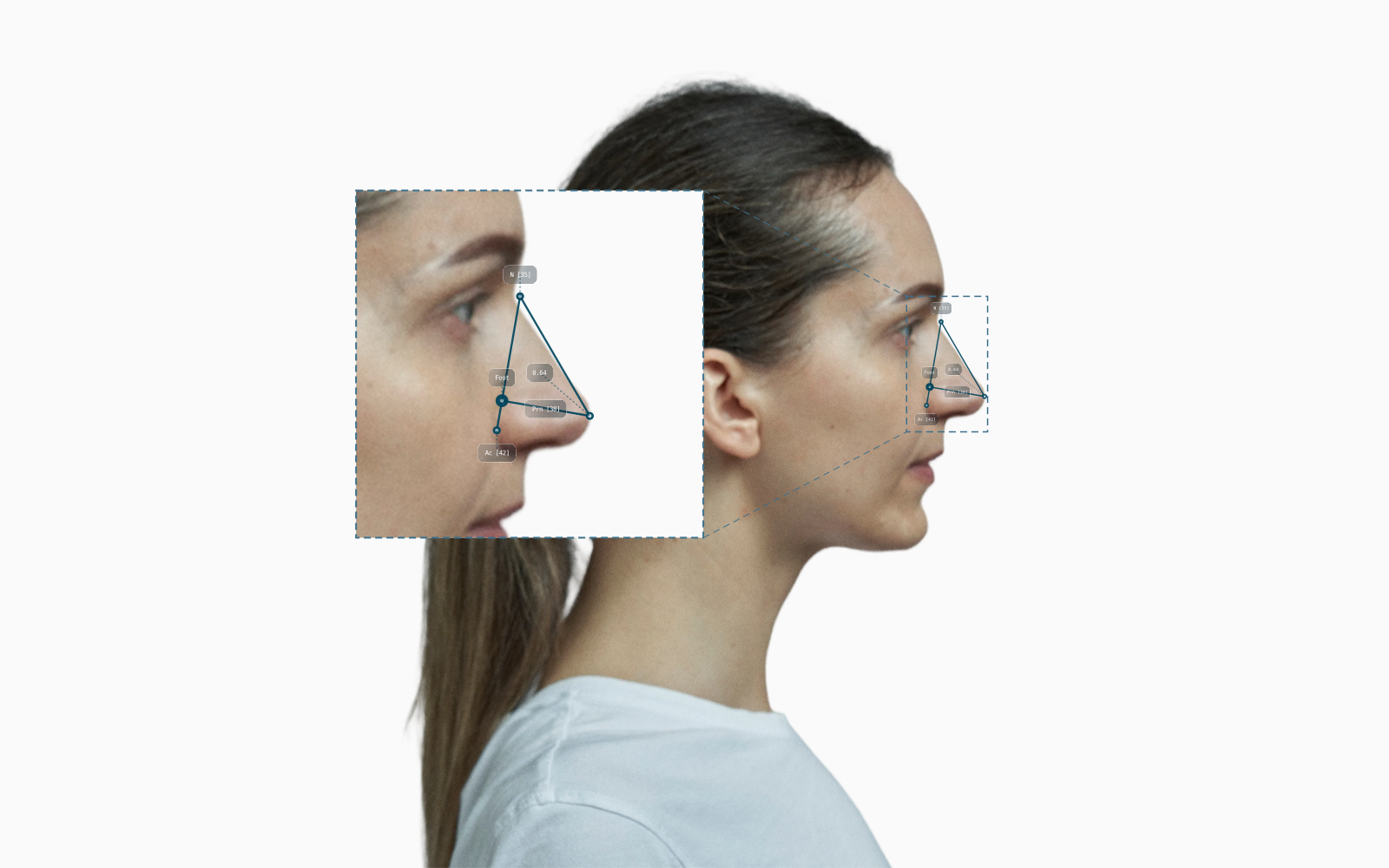
How It's Measured
Nasal tip projection is a side-profile reading. The most common way to score it is the Goode ratio, which compares how far the tip sticks out to how long the nose is, so the answer stays the same whether the photo is big or small (Naini, 2011).
Draw a line from the nasion to the tip, then measure how far the tip stands off a vertical dropped through the alar crease. Divide that projection by the length of the nose and you have the Goode ratio (Ballin, 2018). A bigger ratio means a tip that reaches further out; a smaller one means a flatter, more tucked-in tip.

Pushing the nose tip further forward raised the Goode ratio from 0.64 to 0.67 on the same face, same lighting, same framing.
Why It Matters
Nasal tip projection is one of the first things the eye clocks on a profile, even if nobody can name it. Too much and the nose looks beaked and pulled forward; too little and the tip looks weak and buried in the face. Rhinoplasty planning treats the right amount of projection as one of the core goals of a good result, because it sets how the nose relates to the lip and the chin around it (Naraghi, 2016).
Here is the part most charts skip: there is no single correct number. Nose projection shifts with ancestry. Compared with the Caucasian noses the classic ideal was built on, African and East Asian tips tend to project less relative to nasal length, and that is a normal population difference rather than a fault (Rohrich, 2010). A Western textbook mean will misjudge a nose it was never drawn from.
Sex matters too. Male and female noses differ in shape and in what reads as balanced, so the same Goode ratio can land differently on a man and a woman (Springer, 2008). Treat the numbers below as a reference line to compare against, not a pass or fail. The card and table give you the working range.
below 0.55
Under-projected
0.55–0.60
Ideal (Goode)
above 0.60
Over-projected
Fig 2. The Goode ratio compares tip projection to nasal length, so it reads the same at any photo scale. These bands are a reference, and the ideal shifts with sex and background.
Demographic Variants
Ideal nasal tip projection varies by population, so one Goode ratio cannot fit every nose. Most of the difference sits in how far the tip reaches relative to the length of the nose. Each row links to its source.
Population | Projection tendency | Source |
|---|---|---|
Northern European / Caucasian | Goode ratio near the classic 0.55 to 0.60 ideal the canon was built on | |
African | Tip projects less relative to nasal length, roughly half rather than two-thirds | |
East Asian | Lower tip projection; augmentation to build the tip forward is commonly sought | |
Hispanic / Mestizo | Thicker skin and weaker cartilage often leave an under-projected tip |
Загрузите чёткую фотографию анфас. При желании добавьте снимки в профиль — всего до четырёх фотографий.
Перетащите файл сюда
НЕОБХОДИМЫЕ РАКУРСЫ
ИИ разбирает 177 параметров лица: видимые особенности кожи, пропорций, глаз, бровей и других черт. Недоступные по снимку показатели не измеряются.


Вы получите план с описанием сильных сторон, черт, которые можно улучшить, и наиболее подходящих способов сделать это.
Отчёт Эммы
16 января 2026 года
Объяснение
Глубина морщин на лбу соответствует норме для вашего возраста и демографической группы и находится ближе к нижней границе ожидаемого диапазона.
Ваши вопросы
On the Goode ratio, the classic ideal for nasal tip projection sits between about 0.55 and 0.60, meaning the tip projects a little over half the length of the nose (Naini, 2011). Below that band the tip reads as under-projected and flat; above it the nose starts to look beaked. What counts as ideal still depends on your sex and your background.
You take a side-profile photo and mark three points: the nasion at the root of the nose, the pronasale at the tip, and the alar crease where the nostril meets the cheek. The Goode method compares how far the tip stands off a line through the alar crease with the overall length of the nose (Ballin, 2018). Because it is a ratio, the reading holds at any photo size.
An over-projected nose has a tip that reaches too far forward, so the profile looks beaked or pulled out. An under-projected nose has a tip that sits too flat and close to the face, which can make the nose look weak or wide (Naraghi, 2016). Both are read against the lip and chin, so the same tip can look right on one face and off on another.
Yes. Compared with the Caucasian norms the Goode ideal was built on, African and East Asian noses tend to have lower tip projection relative to nasal length (Rohrich, 2010). Hispanic and mestizo noses often carry thicker skin and weaker tip cartilage, which reads as an under-projected tip as well (Cobo, 2010). A single ideal misreads many of these profiles.
Yes. Increasing nasal tip projection usually means adding support to the tip with cartilage grafts or sutures, while reducing it means shortening or repositioning that framework (Rohrich, 2010). Getting projection right is treated as one of the main aims of a balanced result (Naraghi, 2016).