1
Загрузите фотографии
Загрузите чёткую фотографию анфас. При желании добавьте снимки в профиль — всего до четырёх фотографий.
Перетащите файл сюда
НЕОБХОДИМЫЕ РАКУРСЫ


Forehead width is the distance straight across the top third of the face, measured between the frontotemporale points where the temples pinch in on either side. It sets how broad the upper face reads, and a wide one is what most people mean when they complain about a big forehead. Far from a flaw, a generous forehead is one of the features that reads as youthful and open on a face.
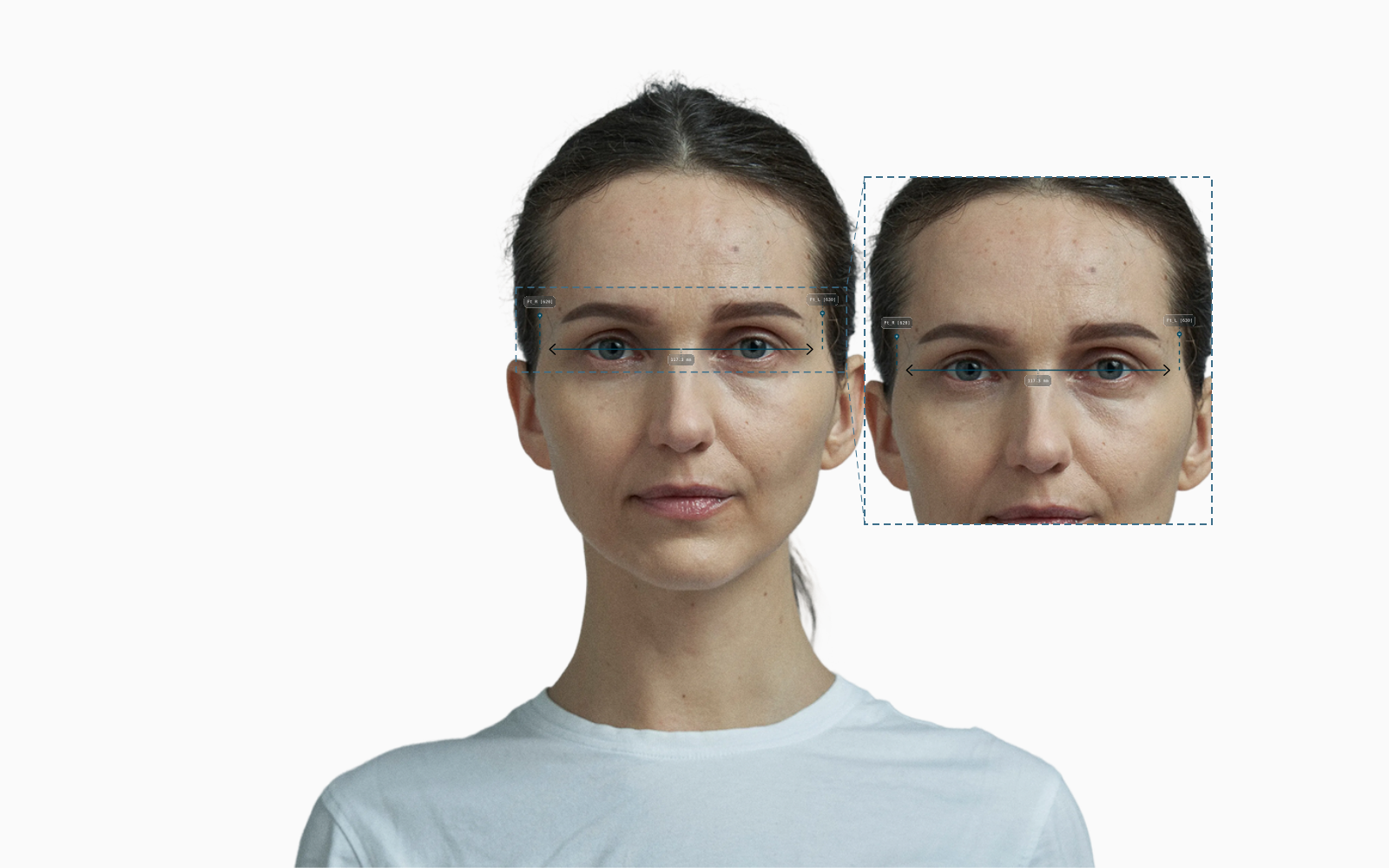
How It's Measured
Forehead width is read as a single horizontal span across the upper face, taken between the two frontotemporale points, the spots where the forehead is narrowest at the temples. It is the widest working measure of the upper third, the segment that runs from the hairline down to the brow (Farkas et al., 1985).
Read against the rest of the face, forehead width tells you whether the top of the face is broad and open or narrow and tapered (Naini, 2011).

Widening the forehead took the temple-to-temple width from 117 mm to 125 mm on the same face. The upper third reads noticeably broader across the temples, while the eyes, cheekbones, lighting and framing stay identical.
Why It Matters
The forehead is the frame for the whole upper face, so its width quietly sets the proportion of everything below it. People tend to worry that a broad forehead looks wrong, but the research points the other way. Adults rate faces with an average or large forehead as more attractive than faces with a small one, and a full, rounded forehead is one of the features that reads as youthful and feminine (Kuraguchi et al., 2015). So a big forehead is closer to an asset than a defect.
Where the complaint usually comes from is proportion, not raw width. A forehead only looks too large when it takes up much more than its third of the face, or when a high hairline stretches the visible skin above the brow. The width itself is often fine. It is the ratio to the middle and lower thirds, and the position of the hairline, that make a forehead read as large.
Forehead shape also carries a sex signal. Male foreheads tend to slope back behind a heavier brow ridge, while female foreheads sit more upright and rounded, part of the broader pattern of facial breadth and bone that separates the sexes (Weston et al., 2007). That is why a wide, smooth, vertical forehead usually reads as feminine and a wide, sloped, ridged one reads as masculine. The cards and table below give working ranges, but read them against the face's own height and hairline rather than chasing a single number.
112–126 mm
Men
105–118 mm
Women
105–126 mm
Typical Range
Approximate temple-to-temple (frontotemporale) width in adults. Forehead width is judged proportionally against face height and hairline, and it varies with individual structure and background.
Demographic Variants
Forehead width is read proportionally, so what counts as broad shifts with sex and population. The pattern below reflects how the upper face tends to sit across groups; each row links to the source.
Population | Forehead width tendency | Source |
|---|---|---|
Women | Broad, upright, rounded forehead reads youthful and feminine, and rates as attractive rather than as a flaw | |
Men | Forehead slopes back behind a heavier brow ridge, so it can look narrower relative to a wider jaw below | |
European | Forehead fills close to one vertical third of the face in the classic proportional canon | |
East Asian | Broader bizygomatic and upper-face breadth on average, so the forehead tends to read wider across |
Загрузите чёткую фотографию анфас. При желании добавьте снимки в профиль — всего до четырёх фотографий.
Перетащите файл сюда
НЕОБХОДИМЫЕ РАКУРСЫ
ИИ разбирает 177 параметров лица: видимые особенности кожи, пропорций, глаз, бровей и других черт. Недоступные по снимку показатели не измеряются.


Вы получите план с описанием сильных сторон, черт, которые можно улучшить, и наиболее подходящих способов сделать это.
Отчёт Эммы
16 января 2026 года
Объяснение
Глубина морщин на лбу соответствует норме для вашего возраста и демографической группы и находится ближе к нижней границе ожидаемого диапазона.
Ваши вопросы
There is no fixed number. A forehead reads as big when it takes up clearly more than its third of the face height, since the classic proportion splits the face into roughly equal upper, middle and lower thirds (Farkas et al., 1985). A high hairline adds to the effect by exposing more skin above the brow, even when the actual forehead width is average.
Often, yes. Adults rate faces with an average or large forehead as more attractive than faces with a small forehead, and a broad, rounded forehead is one of the features tied to a youthful, feminine look (Kuraguchi et al., 2015). A big forehead is far more of an asset than the word makes it sound.
Forehead width and height are mostly set by your skull shape and hairline, both of which are inherited. Male foreheads also slope back behind a stronger brow ridge while female foreheads sit more upright, part of the bone pattern that differs between the sexes (Weston et al., 2007). A receding or naturally high hairline can make an average forehead look larger than it is.
Most of the fix is styling rather than surgery. A fringe or curtain bangs shorten the visible forehead instantly, and brows kept full rather than over-plucked balance the upper face. When the concern is a genuinely high hairline, hairline-lowering surgery can advance it, but for most people a large forehead is best handled with hair framing, not a procedure.