1
Загрузите фотографии
Загрузите чёткую фотографию анфас. При желании добавьте снимки в профиль — всего до четырёх фотографий.
Перетащите файл сюда
НЕОБХОДИМЫЕ РАКУРСЫ


The palpebral fissure is the almond-shaped opening between your upper and lower eyelids, sometimes called the eye aperture. Its length, its height, and the slant of its corners decide how open or tired the eye looks. FASEVA reads it by landmarking the inner and outer corners and the lid margins.
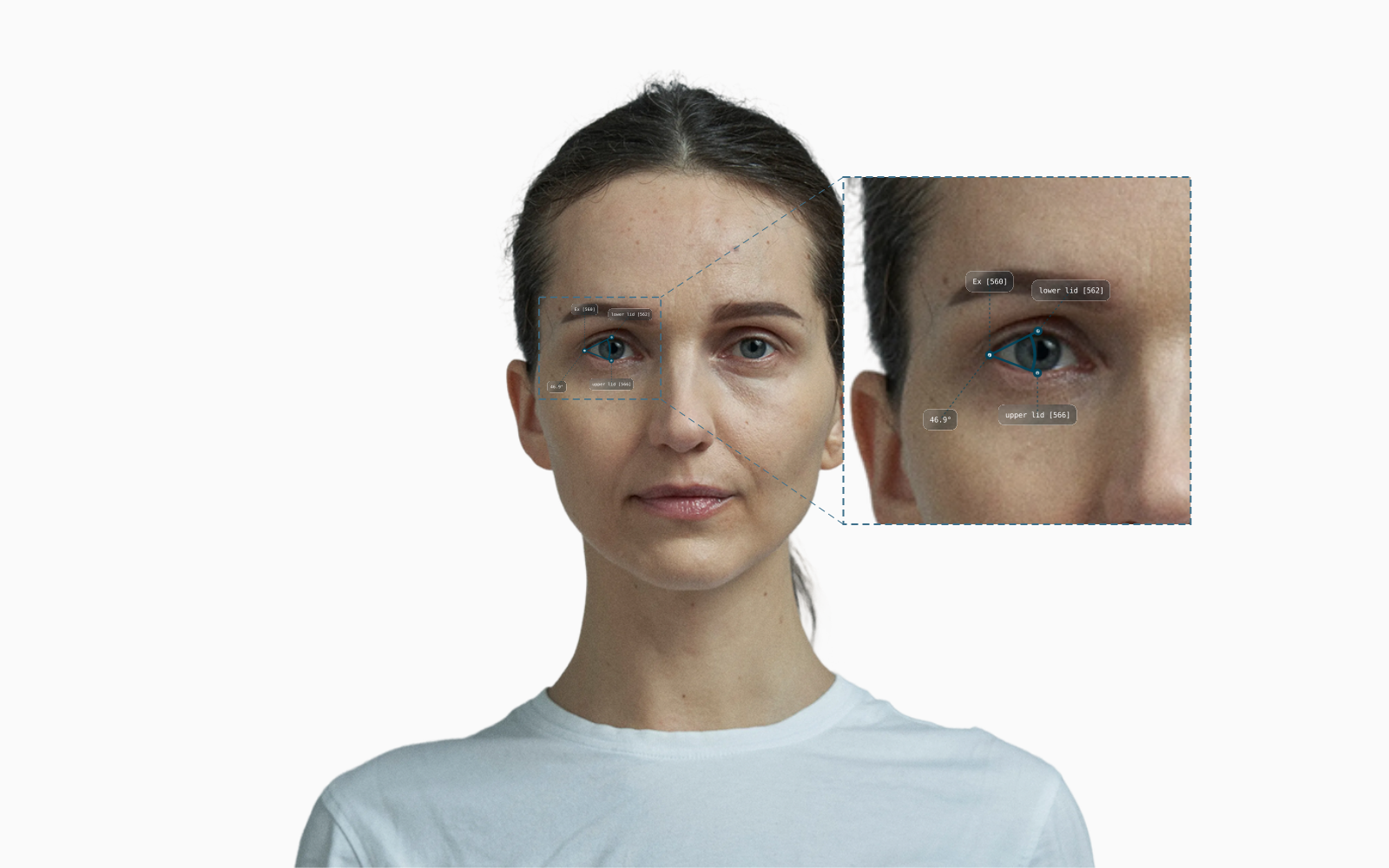
How It's Measured
The palpebral fissure is the gap between the upper and lower eyelid margins, running from the medial canthus at the inner corner to the lateral canthus at the outer corner (Knezi et al., 2020). FASEVA places landmarks on both corners and both lid margins, then reads the opening three ways.
Read together, these tell you whether an eye looks long and open or short and narrow, and whether the outer corner sits level, upturned, or downturned (Armengou et al., 2023).

Opening the eyelids widened the palpebral fissure aperture angle from 47° to 55° on the same face, same lighting, same framing.
Why It Matters
The eyes pull more attention than any other feature of the face, so the shape of the palpebral fissure carries a large share of the first impression (Peshek et al., 2011). A long, open fissure with a slight upward tilt at the outer corner reads as youthful and awake. A short or narrowed opening reads as tired or heavy-lidded.
There is no single ideal shape. Fissure length, height, and the outer-corner slant all vary by ancestry and sex, and the slant in particular differs enough between populations that one universal target misreads many faces (Knezi et al., 2020). East Asian eyes, for instance, tend toward a more upward slant than European ones (Armengou et al., 2023).
The fissure also carries clinical weight, which is why oculoplastic surgeons landmark it routinely. Symmetric narrowing can follow a metabolic or congenital syndrome, while one-sided change usually points to trauma, nerve palsy, or an orbital mass rather than anything cosmetic (Knezi et al., 2020). The cards and table below give working ranges, but read them against sex and background.
30–31 mm
Men
28–30 mm
Women
27–31 mm
Typical Range
Typical adult palpebral fissure length. These values vary depending on individual facial structure and background.
Demographic Variants
Palpebral fissure length and outer-corner slant vary by population, so the ideal is relative, not absolute. Each row links to the study that measured it.
Population | Palpebral fissure tendency | Source |
|---|---|---|
European | Near-horizontal slant; length close to intercanthal width | |
East Asian | Narrower vertical opening, more upward outer-corner slant | |
African | Fissure length frequently exceeds intercanthal distance | |
Southeast Asian | Slightly shorter fissure than European norms | |
Middle Eastern | Fissure dimensions comparable to European samples |
Загрузите чёткую фотографию анфас. При желании добавьте снимки в профиль — всего до четырёх фотографий.
Перетащите файл сюда
НЕОБХОДИМЫЕ РАКУРСЫ
ИИ разбирает 177 параметров лица: видимые особенности кожи, пропорций, глаз, бровей и других черт. Недоступные по снимку показатели не измеряются.


Вы получите план с описанием сильных сторон, черт, которые можно улучшить, и наиболее подходящих способов сделать это.
Отчёт Эммы
16 января 2026 года
Объяснение
Глубина морщин на лбу соответствует норме для вашего возраста и демографической группы и находится ближе к нижней границе ожидаемого диапазона.
Ваши вопросы
The palpebral fissure is the almond-shaped opening between the upper and lower eyelids, running from the inner corner (medial canthus) to the outer corner (lateral canthus). In adults its length averages around 27 mm (Knezi et al., 2020).
In healthy adults the horizontal palpebral fissure length runs roughly 27 to 31 mm, with men averaging slightly longer than women (Knezi et al., 2020). An opening much shorter than this is described clinically as a short palpebral fissure.
A symmetrically narrowed palpebral fissure can follow a metabolic disease or a congenital syndrome, while one-sided narrowing usually points to trauma, facial-nerve palsy, or an orbital mass. For that reason the finding is assessed medically rather than treated as a cosmetic feature in isolation (Knezi et al., 2020).
An upslanting fissure has the outer corner sitting higher than the inner corner, a positive canthal tilt that is more common in East Asian eyes and tends to read as open and youthful. A downslant lowers the outer corner and can read as tired (Armengou et al., 2023).